

Why Most Driving Scenes Are Shot the Hardest Way Possible
Most driving scenes are not complicated.
They just get treated that way.
A director needs a performance.
A DP needs consistency.
A producer needs the day to move.
Somewhere between those three goals, productions choose the most difficult option available and then spend the rest of the shoot trying to control it.
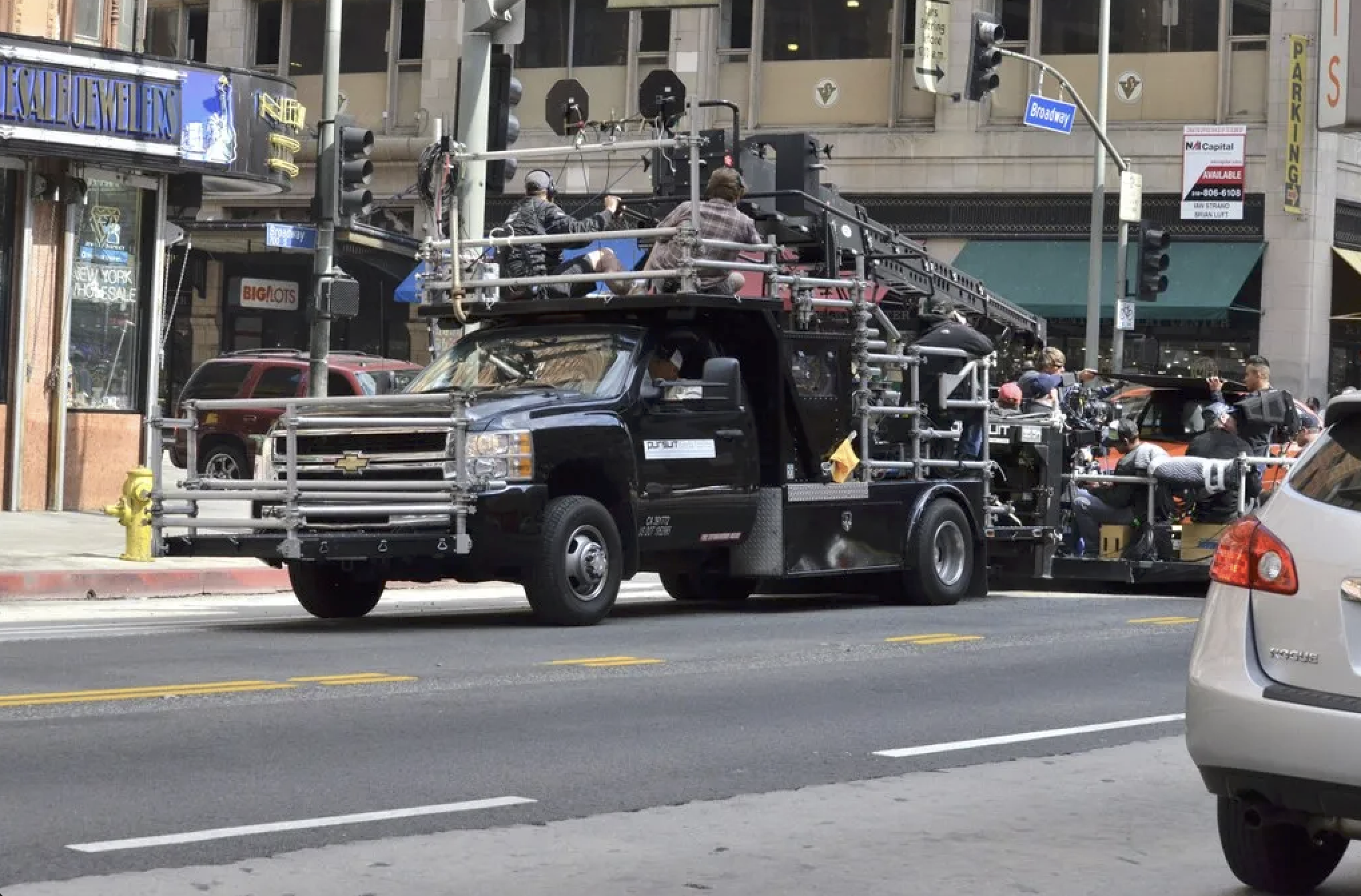
This happens most often with interior car scenes, where productions default to process trailers or green screen even when neither is the best fit.
The default choices
For interior driving scenes, productions usually fall into two camps.
Put the car on the road and figure it out.
Or put the car on a green screen and fix it later.
Both approaches can work.
Both are also responsible for a lot of scenes that never quite land.
On the road, the environment takes over.
Light changes constantly.
Sound becomes a problem.
Continuity slips.
Resets take longer than expected.
Performances flatten because the actor is reacting to traffic instead of the scene.
On green screen, the opposite happens.
Everything is controlled, but nothing feels connected.
The light does not behave the way the background does.
Reflections stop making sense.
Actors lose their relationship to the world outside the windows.
The scene becomes technically correct and emotionally thin.
Most productions accept these tradeoffs because they assume there is no middle ground.
Rear projection driving exists in that middle ground, even though many crews forget it does.
The real problem is not realism
A lot of conversations about driving scenes get stuck on realism.
How real does it look.
How convincing is the motion.
That is not where most scenes succeed or fail.
What breaks a driving scene is inconsistency.
Light that does not match shot to shot.
Reflections that change direction between angles.
Background motion that does not line up with performance.
Actors reacting to something that is not there.
Audiences will accept exaggeration.
They will not accept behavior that feels wrong.
This is why so many driving scenes feel off even when the budget is high.
The tools were chosen based on logistics, not behavior.
Why productions make it harder than it needs to be
Process trailers are powerful, but they introduce variables that are hard to tame.
Green screen is flexible, but it demands precision that often gets deferred until post.
In both cases, the production spends energy compensating for the method instead of serving the scene.
Time gets burned waiting for conditions to cooperate, or resetting coverage that never quite matches.
Coverage gets compromised to stay on schedule.
Post becomes responsible for fixing problems that were baked in on set.
None of this is controversial.
Everyone has experienced it.
What is surprising is how rarely productions stop and ask whether the difficulty is necessary.
Interior driving scenes are not exterior stunts
Most interior car scenes are about people, not motion.
Dialogue.
Tension.
Eye lines.
Micro reactions.
The world outside the car matters only insofar as it supports those things.
When the environment becomes the dominant force, the scene often suffers.
Not because the environment is wrong, but because it is uncontrolled.
This is where rear projection gets misunderstood.
It is not a visual trick.
It is a workflow choice.
Control is the point
Rear projection exists for one reason.
To make the environment behave.
That includes realism.
It also includes repeatability.
It includes lighting that responds correctly to the image.
It includes reflections that make sense across angles.
It includes actors who can actually see the world they are reacting to.
That is why it is often used as an alternative to process trailers or green screen for interior driving scenes.
None of that requires the scene to be slow or subtle.
Fast insert shots still benefit from consistency.
Montage sequences still benefit from continuity.
Chaotic moments still need the light and motion to agree with each other.
Control does not remove energy.
It removes accidents.
Why this gets overlooked
Rear projection has a reputation problem.
People associate it with older techniques or assume it is limiting.
In practice, most limitations come from trying to force other methods to behave.
On the road, the crew fights physics.
On green screen, the crew fights separation.
Rear projection solves a different problem.
It aligns the image with the performance at the moment it is captured.
That is why it quietly replaces more complicated solutions when the goal is a believable interior scene.
This is not about using one tool everywhere
No single method is correct for every shot.
Exterior chase work belongs on the road.
Shots that depend on genuine unpredictability should stay real.
Moments where the camera is discovering the world benefit from being in it.
Interior scenes where performance carries the weight are a different category.
Those scenes do not need danger.
They need precision.
The mistake is treating all driving scenes as if they have the same requirements.
The harder way is often the familiar way
Most productions do not choose difficult solutions because they want to.
They choose them because they are familiar.
They know how to schedule them.
They know how to explain them.
They know what problems to expect, even if those problems are costly.
Rear projection challenges that familiarity.
It asks a simple question.
What if the environment worked with you instead of against you.
For interior driving scenes, that question changes everything.
The practical takeaway
If a scene lives or dies on performance.
If continuity matters.
If time on set is precious.
If realism needs to hold up under scrutiny.
There is no reason to choose the hardest path by default.
Rear projection is not a novelty.
It is not a compromise.
It is a practical alternative that solves problems productions have learned to tolerate.
And once you stop tolerating them, it becomes hard to justify doing it the old way.
For productions looking for a controlled, in-camera alternative to process trailers and green screen, rear projection driving is what this stage was built for.
Learn more at rearprojectiondriving.com